
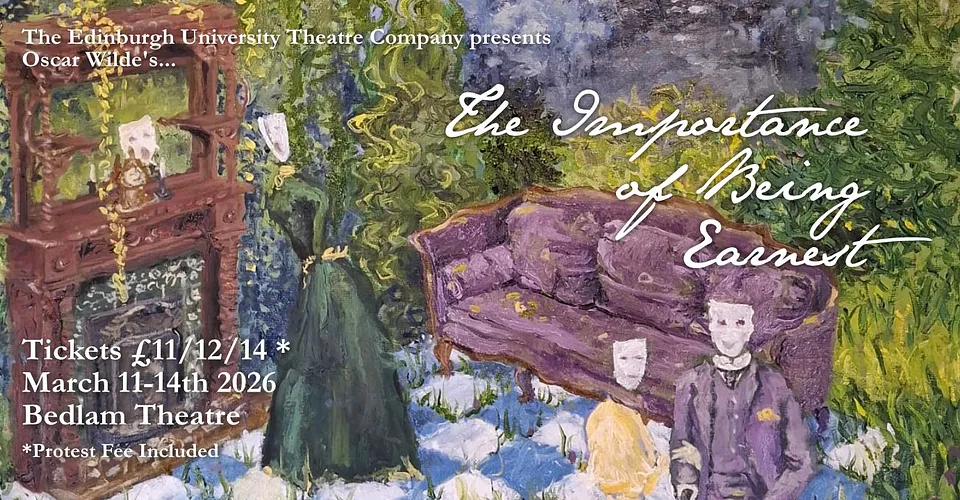
“In matters of grave importance, style, not sincerity is the vital thing.” Thus, we ponder, in matters of no importance, is the vital thing sincerity, not style?
Wednesday 11 March - Saturday 14 March 2026
£11/12/14
The paradigm of Wildean comedy, “The Importance of Being Earnest”, By Oscar Wilde, is “a trivial play for serious people”. The play follows characters, richly saturated with eccentricity, and their romantic ramblings within the rigidly ritualistic Victorian upper class. For over a century, Wilde’s artwork has held up a looking glass to society, reflecting the hilarity of its behaviours, superfluous as well as profound, and revealing to us, through preposterous circumstances, with a delectable wit, that “the truth is rarely pure and never simple”.
In acknowledgement of the University of Edinburgh’s financial entanglement in the Palestinian Genocide, the Earnest production team has added a £4 protest charge to each ticket which will be directly donated to Medical Aid for Palestinians.
Running time: 2h 45m (including 2 intervals)
Latecomers will be allowed within 15 minutes of show start.
Age rating: 13+
Show contains some moderate adult language and mild sexual references (13+).
Show contains mild adult situations (smoking, drinking) and may address adult topics such as death and divorce (13+).
Content Warnings:
Mentions of abuse, child neglect, death/loss of family members and self-harm/suicide.
Allusions to sexual assault, body shaming, pregnancy/childbirth and racism.
Technical Warnings:
*Please contact [email protected] for more information.
Friday 13 March - By Hugh Simpson for All Edinburgh Theatre
The EUTC’s production of The Importance of Being Earnest at the Bedlam is careful and intelligent. It may ultimately lack a little sparkle, but makes up for it in many other ways.
Oscar Wilde’s ‘trivial comedy for serious people’ has been constantly popular, with its depiction of the tangled lives of two young gentlemen as they lead double lives to avoid the expectations of society.
There have been some recent productions that have done some decidedly odd things to the play. One that had much older performers as Jack and Algy, and another that attacked the text at 100 miles an hour in order to fit it into a Fringe slot, remain fresh in the mind (and not necessarily for good reasons).
Some of the more successful recent versions have leant into the play’s obvious reflections of Wilde’s own history – the secret life, the ‘Bunburying’ and so on – that it has almost become expected to see Lady Bracknell played by an actor identifying as male.
Director El Mair’s contribution to this comes in the elegant gender-swapping of the four young lovers, with Algernon and Jack played by Ella Peattie and Safiya Kilroy-Friedman, and Gwendolen and Cecily by Zac Askham and Tai Remus Elliot. This works beautifully, and (like everything else in the production) is the result of obvious thought and consideration by Mair.
Anything that doesn’t quite come off in the production tends to be the result of over-ambition rather than carelessness; Mair clearly knows exactly what they are doing, and this is another in a series of recent Bedlam productions that combines an understanding of the text with imagination and considerable theatrical nous.
Peattie and Kilroy-Friedman are both extremely impressive, with Peattie managing some of the always tricky business of eating while acting exceptionally well. Indeed, the afternoon tea scene, with its pile of muffins, is as good as you could hope to see. Both performers display considerable relish in their portrayals of the double-dealing but essentially decent young fellows.
There is a delicacy and poise to the characterisations that is mirrored by Askham and Remus Elliot, whose first meeting is probably the production’s funniest scene.
Claudia Collins’s Lady Bracknell is another considered characterisation, much more reserved and human than is often the case. And great credit for a ‘handbag’ line that has an impact, while not being delivered in the familiar Edith Evans way.
Thomas Knibbs gives Canon Chasuble the appropriate level of fustiness, while Karis Halpin’s Miss Prism is finely drawn. Meri Suonenlahti’s portrayal of the two butlers also deserves praise.
A commitment to diligently placed dialogue and appropriately cut-glass accents is in evidence throughout. This leads to some odd moments (such as a servant who sounds even posher than their employer) and can have an effect on the delivery. There is the occasional moment that is just too quiet, and some of the best jokes are difficult to make out.
The pacing is very good, but the rhythm often comes into the ‘nearly but not quite’ category, so the dialogue does not always have the necessary pizzazz. The humour could do with more emphasis. The production does not lack for archness (Suonenlahti applies a ludicrous moustache in full view of the audience, and affects an exaggerated French accent as Merriman) so could easily stand a touch more exaggeration. There is also the occasional instance of performers screening others from the audience’s view or delivering lines facing away from them.
The replacement of gender-specific pronouns with ‘they’ and ‘them’ in the lines makes perfect sense, and isn’t even noticeable unless you are specifically looking for it. The older characters’ constant use of ‘thou’ for ‘you’ is another matter. For whatever reason it is done, it sounds intrusive, and leads to some awkward constructions.
There are also a couple of odd pronunciations that would largely pass by without comment, with the exception of the American version of ‘lieutenant’, which sticks out like a sore thumb.
While it is something of a relief to have a three-act play with the requisite two intervals, things do get somewhat drawn out. The set (co-managed by Ava Tumblety and Tanya Molleson) is inventive. The changes, performed by stagehands complete with servants’ outfits and coal-scuttle hats, are interesting to watch, but the complex fly system managed by Fiona Connor can prove recalcitrant, and all the re-setting just takes too long in a production approaching three hours.
Similarly, the use of onstage ‘statues’ performing music under the musical direction of Jasper Fuller is a mixed blessing. The music (string versions of songs of various vintages, but all much more recent than Wilde’s era) is intriguing, and the musicians’ presence leads to one wonderful sight gag, but once again it is just overused. When the audience is unsure whether an act has started or ended, or the curtain call is delayed as much as it is here, then some rethinking is needed.
Nhi Tran’s costume design is exceptionally good, making striking use of a bold colour palette. Aaron Rashid’s lighting is tremendously effective, while the sound design of Atalanta Lewis is thoroughly evocative, although prone to overuse, with characters’ words fighting against recorded street noises on one occasion.
Once again, however, any faults are down to an excess of invention or imagination rather than a lack of them, which is exactly how it should be. As Gwendolen points out, perfection would leave no room for development.
Saturday 14 March - By Finlay Clench for The Student
The Importance of Being Earnest is a fervent romp of a play which propels itself to Bedlam’s stage with style. Although a little over-exuberant in places, earnest is clearly not the word here as the actors look to exploit and satirise the Shakespearean storyline which the piece hangs from. They mock Wilde’s farce, and move beyond its strict, formal nature.
The energy the actors provide is commendable — it is infectious throughout the piece. At points, the piece becomes adequately romcom-esque, as the audience is sucked into some kind of mainstream TV drama before realising you are watching a play from the late 19th Century. The actors, especially Ella Peatie as Algernon, play off of the performative, obnoxious society this play is encased in. Claudia Collins is impressive as Lady Bracknell, injecting scenes with a stern, rigorously controlled voice. Jack — played by Safiya Kilroy-Friedman — adopts this heightened characterisation well and makes events unbelievable in the best way possible.
While this style works throughout the production as a whole, in the initial scenes the non-serious, playful style does take a little adjusting to. The actors feel a little tentative onstage, which leaves moments feeling a bit lacking in purpose and it hard to develop a connection to a character. Some moments feel a little preemptive or unsure.
Security in this style comes with the arrival of grandiose, genius duo Tai Remus Elliot and Zac Askham who flaunt themselves into the action as the ladies who compete for the imaginary Earnest (the man whom the women are both engaged to marry who ironically does not exist). Playing Cecily and Gwendolen respectively — they contaminate the stage with their stunning chemistry. Mulling over breakfast muffins or sitting at a garden table, they grasp the audience in the palms of their hands, delivering line after line with sublime comedic address.
Director El Mair throws everything at this production, and sometimes everything is a little too much. While the directing is fittingly done to suit the reminiscent style of the production, often the beautiful directorial vision is consumed by the sound or set design.
The set design is ingenious, offering a highly mutable landscape for each section — curtains suspended to section off rooms onstage or transport us to a garden. However, while impressive and plays into the excessive period style to the piece, the design causes more problems than it is worth. Curtains get caught on props, and the long scene change breaks are unnecessary. The integration of the backstage team into costumes is clever, and shows a similar concern for detail as with the set. Attention to detail is continued through directing which means that the production is engaging throughout.
The production’s ambition and aspiration is exciting, although it would be better to do a little less and still provide the camp love fest which Oscar Wilde always promises.
Thursday 12 March - By Will Osborn for A Young(ish) Perspective
When a classic play (or any text being adapted for that matter) has action revolving around mistaken or falsified identity, it begs a queer reading. ThinkComedy of Errors or Accidental Death of an Anarchist. Techniques of gender rearrangement are popular devices in the modern theatre. And EUTC’s The Importance of Being Earnest adds to that conversation.
Directed by El Mair, this is a beautiful production. Intricate fly systems elevate curtains that imitate windows and walls. These systems were complex but executed smoothly, revealing a delightful garden set once used. Bedlam Theatre offers a versatile space, so to have it utilised to such great effect is superb to see. The Set Team, led by Ava Tumblety and Tanya Molleson, should be very proud of their work.
To accompany these transitions, a live band (led by Musical Director Jasper Fuller) plays string renditions of Say My Name and The Mystery of Love (from Call Me By Your Name, a piece of lo-fi queer cinema that may have offered some inspiration for this production). These musical accompaniments were well-arranged and well-executed, adding a smooth, lo-fi vibe to the bookending of each act.
To top it off, Costume Design by Nhi Tran is absolutely exquisite. The pieces are time specific yet individualised enough to stand out and accompany the queered direction, including a repeated use of purple and yellow to indicate opposite factions that ultimately mix together in the end. This attention to detail through colour shows a deep understanding of the text. This was a true highlight of the show.
Lighting Design by Aaron Rashid and Sound Design by Atalanta Lewis added a serviceable amount of atmosphere to the piece, but occasionally struggled to add moments with the same impact as these other elements. However, altogether, the design elements make for a delightfully peaceful atmosphere, which helped pace this nearly three-hour production. Still, it is hard to say whether or not this peaceful atmosphere is entirely effective for the text at hand. This query was particularly evident in the direction and performances.
Mair’s direction seems acutely aware of the potential for comedy within Wilde’s text (after all, one-liners and chaos are present throughout). This is evident in the gender swapped core cast, which makes room for humorous exaggerations of particular types within the social conscious. And while laughter certainly occurred due to this, it never reached the heights which Wilde’s text indicates. Characters never truly let loose, as so many scenes indicate they should, and they lack the emphasis necessary to carry such a speech-ridden text. They seem to be calmed-down versions of what we expect from this text. Perhaps this was intended to accompany the more lo-fi aesthetics of the production, but this doesn’t entirely compliment the dialogue and action. Instead, performances seem more focused on creating accurate RP accents and social gestures, while never truly exaggerating them to a point of comic effect. What results are characters that aren’t quite believable, but aren’t quite unbelievable so to speak. There are still standouts in the cast. Namely, Tai Remus Elliot as Cecily Cardew, who was capable of exaggerating and restraining their performance to great comedic effect at times.
The core tenant of a text like this is unpredictability; Wilde’s plot revolves around a complex web of lies that mount overtime, yet it somehow works out in the end. Some more focus in the future on generating humorously unpredictable performances will push this production much further.
In the end, this is a beautiful, engaging and occasionally funny production of a classic play, with room to improve.